

Underwriting
Credit scoring and limits
Scorecards, gradient boosting and neural networks for application and behavioural scoring. Each decision is stored with its reasons, model version and reference population.
Solutions · Banking and lending
Kaimei attaches to the scorecards and machine-learning models a bank already runs. It gives each decision its specific reasons, gives validators evidence they can reproduce, and watches production for the drift that scores alone do not show.
Where it fits
Kaimei attaches to models you already run. It does not replace them, serve them or retrain them.
Underwriting
Scorecards, gradient boosting and neural networks for application and behavioural scoring. Each decision is stored with its reasons, model version and reference population.
Customer notices
The inputs that pushed this applicant toward decline, ranked and reproducible, ready to map onto your approved reason table.
Second line
Global importance, behaviour curves with their direction, learned rules, interactions and robustness: evidence a validator can rerun with the same seed.
Financial crime
Why a payment was held, from the model's own inputs. Models that Kaimei cannot run are explained through your scoring endpoint.
Portfolio
Behavioural models watched for drift in every input, with alerts that name the input that moved.
Finance
Probability of default and loss estimates under IFRS 9 and CECL are numeric predictions; Kaimei explains them in their own units.
A worked example
Public dataDefault of Credit Card Clients, UCI Machine Learning Repository (Yeh & Lien, 2009).credit-default-forestscikit-learn · random forest
30,000 card clients of a bank in taiwan, april to september 2005. A 30-tree random forest predicts default on next month's payment from ten account inputs; sex and marital status are left out. It is trained on 24,000 clients, uploaded with one client.models.upload call, and every figure below is what the Kaimei API returned.
POST https://api.kaimei.ai/v1/explanations
Reasons for a notice
Suppose the bank cuts the credit line of client 1518, an adverse action on an existing account. The model puts the chance of default at 70.8% against an average of 25.3%. The pushes toward default, strongest first, become draft reasons through a table your compliance team owns.
Two rows need a person. A falling balance has no approved wording. And age pushed +0.7 points toward default: small, but a reviewer should see it before a notice goes out.
The adverse action guide, with code| Input | Value | Push toward default | Draft reason (example wording) |
|---|---|---|---|
repayment_status | 2 months late | +21.6 pts | Poor credit performance with us |
worst_status_6m | 2 months late | +11.4 pts | Poor credit performance with us same reason as above; related inputs share one line |
prior_status | 2 months late | +8.9 pts | Poor credit performance with us same reason |
bill_growth_6m | −7% of limit | +2.4 pts | Not in the reason table. Held for review. |
utilization | 94% | +0.9 pts | Proportion of balances to credit limits is too high |
age | 49 years | +0.7 pts | Never stated. Age is a prohibited basis under the Equal Credit Opportunity Act, with narrow exceptions. Escalate for model review. |
payment_ratio | 3% | +0.5 pts | Not in the reason table. Held for review. |
Example wording in the style of Regulation B's sample forms. Regulation B's commentary notes that more than four reasons is unlikely to help the applicant.
On the record
Every explanation is stored with what produced it: the method, the seed, the reference sample, the model version and the 59,485 model calls it took. This is client 1518's, opened in the dashboard.
A reviewer can find it months later by the decision's own id, and running it again returns the same numbers.
What an explanation record holds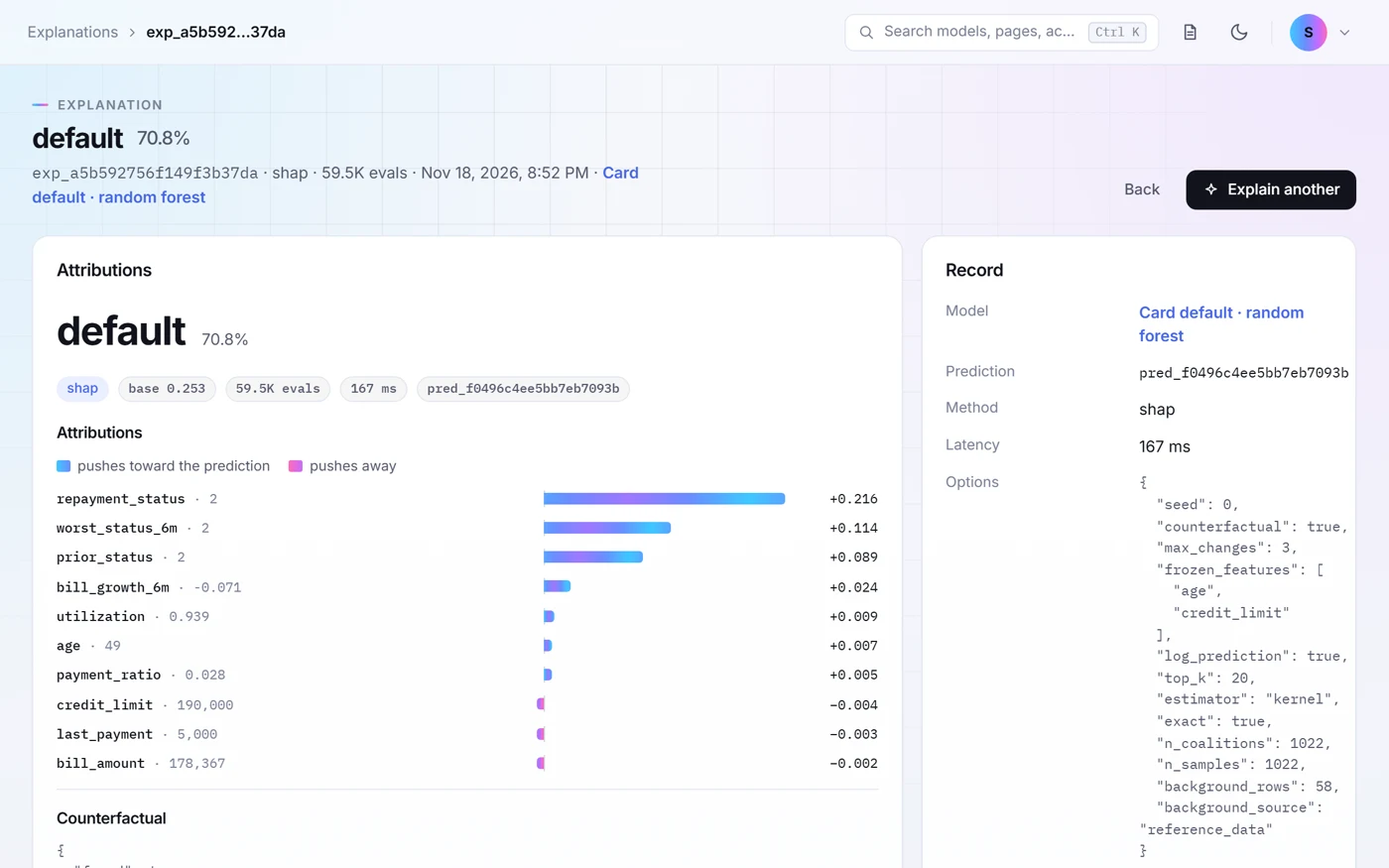
Champion and challenger
The forest and a logistic scorecard trained on the same inputs agree on 95.4% of held-out clients. On client 1105 they agree to the decimal: 54.6% and 54.6%.
Their reasons do not. The forest reads one month late as mildly reassuring next to a worse history (−1.2 pts); the scorecard charges it +8.1 pts. And the scorecard credits this client 5.1 points for having paid nothing at all. That is a question for the validator, and accuracy alone would never have raised it.
Conceptual soundness
One analysis call studies the model across 2,000 reference clients. Repayment history carries most of the weight, and the model responds to it in one direction only.
It also reports what it is unsure of: 0.8% of decisions flip under 5%-σ input noise. Most fragile inputs: bill_amount, last_payment.
repayment_status increases the probability of default, most sharply between 1 and 2 (range 19% → 42%).worst_status_6m increases the probability of default, most sharply between 1 and 2 (range 17% → 34%).utilization has a non-monotonic effect on the probability of default: it bottoms out around 0.09949 (range 21% → 24%).worst_status_6m is the most influential input, followed by repayment_status and prior_status. Together they carry 65% of the measured importance (permutation importance over 2000 rows).Ongoing monitoring
Five hundred held-out clients are logged as normal traffic, and every input is stable. Then a feed starts sending utilisation as a percentage, 94 where the model expects 0.94. Nothing errors. The average score moves from 21.2% to 22.6% and only 2 of 500 decisions change, so a monitor that watches outputs stays quiet. Kaimei compares each input with the reference clients and flags utilisation in the first batch.
utilization. 500 logged predictions against 5,000 reference rows.Population stability index per input. Bars are cut off at 0.5; the line marks 0.25, where Kaimei calls drift significant.
Who it is for
Rerun any analysis with the same seed and get the same numbers. Compare a challenger with the champion input by input, and keep the result with the validation file.
Retrieve the explanation for any decision by your own application id, months later, with the model version and reference population it was computed against.
Upload a fitted estimator in one call. See where two models disagree before the committee asks, and get an alert that names the input when production drifts.
Rules and guidance
| Rule or guidance | What it asks of a model | Where Kaimei helps |
|---|---|---|
| US model risk guidanceInteragency guidance of April 2026 (SR 26-2, OCC Bulletin 2026-13, FDIC FIL-15-2026), which replaced SR 11-7 | Sound development, and validation covering conceptual soundness, outcomes analysis and ongoing monitoring. It names interpretability measures as one practical way to assess conceptual soundness. | Importance, behaviour curves, rules, interactions and robustness for validation; drift and alerts for monitoring; every result stored with its options and seed. |
| UK model risk principlesPRA SS1/23, for firms with internal model approval | Model identification, governance, development, independent validation and risk mitigants. | The same evidence, exportable as JSON for the model inventory. |
| Adverse action noticesEqual Credit Opportunity Act and Regulation B, 12 CFR 1002.9 | A statement of the specific, principal reasons for the action taken. | Ranked, reproducible reasons per decision, and a counterfactual with protected inputs held fixed. |
| EU AI ActRegulation (EU) 2024/1689, Annex III: creditworthiness and credit scoring of people. High-risk obligations apply from 2 December 2027 | Risk management, logging, transparency to deployers, human oversight, accuracy and robustness. | Logged predictions and explanations, robustness and drift analyses, and explanations for the people doing oversight. |
| GDPRArticles 15(1)(h) and 22 | Meaningful information about the logic involved in automated decisions. | A stored explanation per decision to draw that information from. |
| ElsewhereOSFI Guideline E-23 in Canada (effective 1 May 2027); MAS Guidelines on AI Risk Management in Singapore (effective 7 October 2027) | Model risk management across the model lifecycle, including AI and machine-learning models. | The same evidence and records. |
Kaimei produces evidence for these processes. It does not make a model, a notice or a filing compliant, and nothing on this page is legal advice. Rules are cited as they stood in November 2026; check what applies to you now.
Guides for risk and compliance teams: Reading an explanation, Adverse action reasons, Model risk management, The EU AI Act.
Coming soon
What we are building now, and what to use until each one ships.
Approval rates and adverse impact ratios across the groups you define, with a check for inputs that act as proxies. Until then, explanations help investigate a finding; they are not a test.
Cut-offs, overlays and manual decisions recorded with each explanation, so the reasons reflect the whole decision and not only the score.
Your approved adverse-action wording kept under change control, so each explanation returns draft reasons and the inputs held for review. Until then, keep the table in your own systems and map the ranked pushes to it, as in the example above.
Records deleted automatically once they pass the period your policy sets. Until then, they are kept until you delete them.
Said plainly. A counterfactual is a property of the model, not advice to a customer. Kaimei describes how the model responds; it does not establish cause and effect.
What works today, and everything on the way, is in Supported models and what’s coming.
Bring a credit model. We will walk through its first explanation with you.